

Why are my dog’s eyes gunky?
One of the reasons why your pet may have gunky eyes could be because they are suffering from dry eye, known clinically as keratoconjuctivitis sicca. It is an uncomfortable and irritating eye condition which some, not all, pets can suffer from, with one of the symptoms being a build-up of thick, sticky discharge around or in the eyelid.
What is dry eye?
Dry eye is a condition that affects the eyes, it is most commonly due to a reduced production of tear film, or tears. This is caused by an autoimmune disease, whereby the lacrimal gland is slowly destroyed overtime, affecting the quantity of tears produced and how lubricated the eyes are. It can also be because tears are of poor quality or that your pet’s tears are not being adequately distributed over their eyes. Left untreated dry eye can lead to inflammation, damage to the eye and can even affect their vision.
Symptoms of dry eye:
- Red, sore or swollen eyes
- A thick, sticky discharge around the eye and in the eyelids
- Excessive blinking
- Squinting
- Rubbing eyes with their paws or on furniture
- Cloudy, a dull appearance or a loss of the eyes ‘shine’
- Recurrent conjunctivitis
Are certain breeds more likely to suffer than others?
There are some breeds which appear to present with the condition more often than others, however any dog can be affected.
- Cocker Spaniel
- West Highland White Terrier
- Pug
- Miniature Schnauzer
- Toy Poodle
- Shih Tzu
- Lhasa Apso
- French Bulldog
- English Bulldog
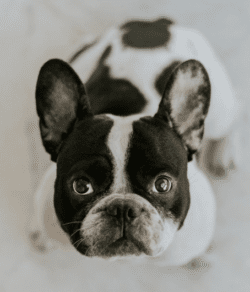
Why are short nosed dog more affected by eye conditions?
Brachycephalic dog breeds are more prone to eye issues than other dog breeds. They are in fact, 3.63 times more likely to suffer from dry eye than others breeds. Below are a few of the reasons why they can be more affected:
- Their eyes often protrude making them exposed to the elements and dryness
- Their blinking ability is often poor, meaning that when they blink it doesn’t always cover the whole oeyes surface
- Due to the compaction of their skull they can have abnormal eyelid anatomy. You may often see overflow of tears causing tear staining and a subsequent lack of tears covering the eyes surface
- They can actually suffer naturally with a poor tear quality in the first place
- As a breed they blink less frequently which reduces lubrication of their eyes
To learn more about eye disease in these dogs – https://domespharma.co.uk/wp-content/uploads/Domes-Pharma-BOS-Owner-Leaflet.pdf
How is dry eye diagnosed?
Your vet may want to perform a schirmer tear test, this involves putting special strips of paper onto your dog’s lower eyelid. There are millimetre markings on the paper strips, we measure how far the tears wet the paper strips over 60 seconds. A reading below 15mm, may indicate that your dog is suffering from dry eye.
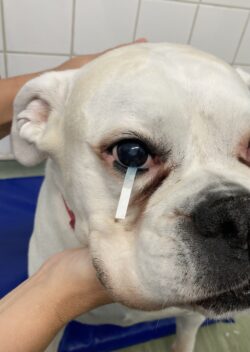
The lovely Pebbles whilst having a schirmer tear test at the clinic
How is it treated?
Dry eye is managed with ointment or drops administered into your dog’s eyes. Your vet or nurse will be able to demonstrate this for you. It can take up to 4-6 weeks to see an difference, treatment will be much more effective if we are managing just a reduction in tear production, rather a managing the complete loss of tear production due to a damaged gland. This is why it is important that the condition is diagnosed and managed early on.
Is it a lifelong condition?
Unfortunately, dry eye tends to be a lifelong condition, so if treating with eye ointment or drops they will have them for the rest of their life. Medication would need to be given daily and you would have to see your vet regularly for check-ups.