

Keyhole Surgery
We are excited to share with our clients a new service being offered from May 2026 – laparoscopic surgery, also known as keyhole surgery.
What is Keyhole Surgery?
Keyhole surgery is a modern, minimally invasive surgical technique. Instead of a larger incision used in traditional surgery, this procedure uses very small incisions and a camera to guide the operation. This allows the surgeon to work with greater precision while causing less disruption to your pet’s body.
You asked, we listened!
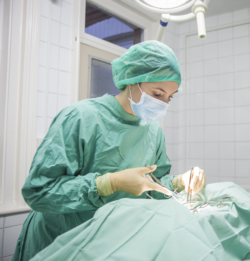
We found that a growing number of owners were asking after keyhole surgery for their pet, particularly when it came to neutering. You asked, and we listened. From May this year, Charlotte will be performing key-hole spays at our clinic, every other Wednesday. Many of you will recognise Charlotte, a much-loved member of the team and a familiar face to many of our clients, Charlotte combines her clinical expertise with genuine compassion.
Why many owners chose keyhole surgery for their dog
When facing surgery, one of the biggest fears pet owners have is pain and a difficult recovery. Keyhole surgery can help reduce these concerns. You may be aware of the many advantages of keyhole surgery in humans, and the same is true for our animal companions. There are many surgical and diagnostic procedures we can perform using the specialised equipment. The most common is keyhole spaying.
Benefits include:
- Less pain after surgery
The surgical technique allows for less tissue trauma and handling, helping your pet feel more comfortable sooner. - Faster recovery
Most pets return to their normal selves much quicker compared to traditional surgery. - Lower risk of complications
The precision of the procedure reduces the risk of bleeding and infection. - Smaller wounds
Tiny incisions heal faster and are less likely to bother your pet. - Earlier return to normal activity
Less exercise restriction and stress for both you and your pet.
We understand how you feel
The thought of your pet undergoing surgery can be worrying. Many owners feel anxious about anaesthesia, pain, and recovery—and that’s completely natural. Your pet is a cherished member of your family, and trusting someone else with their care, even briefly, can feel overwhelming. Your pet’s safety and comfort are always our top priority, we treat every pet as though they are our own. We have a state of the art monitoring equipment, looking at heart rate, blood pressure, carbon dioxide and oxygen levels and your pet will always be monitored by one of our qualified veterinary nurses.
On the day of surgery
We know this can be the hardest part—leaving your pet with us. Rest assured our team will treat them with the same care and compassion we would give our own animals.
Frequently asked questions
- Will my pet be sore after the procedure? In a conventional spay, the ligaments connecting the ovaries to the abdomen have to be stretched, which causes pain. With keyhole spaying these ligaments are cauterised and cut, which is significantly less painful.
- How much hair is clipped? Due to the positioning of the instruments, is it necessary to clip a large area of hair on the sides and the belly. This ensures the area is sterile for surgery.
- Will a buster collar be required? Both small incisions are closed with dissolvable stitches under the skin, so most pets do not pay attention to the wounds. It is important to ensure they don’t lick, so occasionally a pet will require a body suit or collar to prevent this.
- How long is the rest period? For a conventional spay pets need to rest for 10-14days, with keyhole procedures the rest time is just 2-3 days so long as the recovery goes as planned.
- Is it safe to leave the uterus behind? Many studies have been performed looking into the risk of leaving the uterus behind. So long as the ovaries are fully removed, there is no benefit to the patient of removing the uterus. In order to develop pyometra, hormones are required, which come from the ovaries. Therefore, without ovaries, it is not possible to develop these conditions. If we see that the uterus looks abnormal during the procedure, we may be able to remove it laparoscopically or may advise converting to open surgery to do so.
- Will my pet be in pain? Your pet will receive appropriate pain relief before, during, and after surgery. With keyhole techniques, discomfort is significantly reduced compared to traditional methods.
When would a key-hole spay not be suitable for my pet?
- If your dog is under 10kg
Due to the size of the instruments and equipment it is not recommended for smaller patients.
- If you dog is elderly
Due to uterine changes that can occur as your dog gets older when they are neutered both the uterus and ovaries are removed. This is a more complex procedure requiring a larger incision.
- If your dog has just come into season
As with a standard approach to neutering female dogs we advise to wait at least 3 months before they are neutered to allow for both their hormones and inflammation to settle, allowing for a safer surgery.
- If you dog has a womb infection (also known as a pyometra)
A larger incision is required if a dog has a pyometra, where the womb is filled with pus, again this allows for a safer surgery.
Reassurance for You
It’s completely normal to feel nervous. Choosing surgery is never easy—but choosing a technique that minimizes pain, speeds recovery, and reduces risk can make a meaningful difference for your pet.
You’re doing the right thing by seeking the best care for them.
If you are interested in choosing key-hole spay for your pet, speak to a member of the nursing team we can discuss the options, costing and whether it is the right choice for you and your pet.